Why West Town's Median Home Price Doesn't Describe Any Actual Home
August 20, 2026
August 20, 2026
Search "West Town median home price" and you will get two numbers, depending on which site you land on first. Redfin's data puts the median sale price near $699,000 in February 2026, climbing to $715,000 across the three months ending in May, a 9.6 percent and 9.1 percent year-over-year jump depending on which window you use. Zillow's modeled home value index, sampling the same neighborhood, landed at roughly $573,000 as of late February 2026.
That is not a rounding difference. That is a $125,000 to $140,000 gap between two organizations looking at the same stretch of Chicago's West Side, just northwest of the Loop. The instinct is to pick whichever number flatters your budget and move on. The better question is why two reputable data sources, sampling the same zip codes, land so far apart. The answer is not a data error. It is that West Town does not sell one kind of home. It sells three, and the median is doing the work of averaging them into a number that describes none of them.
West Town's housing stock spans roughly a century and a half of construction, and that history shows up in the transaction data as three distinct product categories rather than one continuous market.
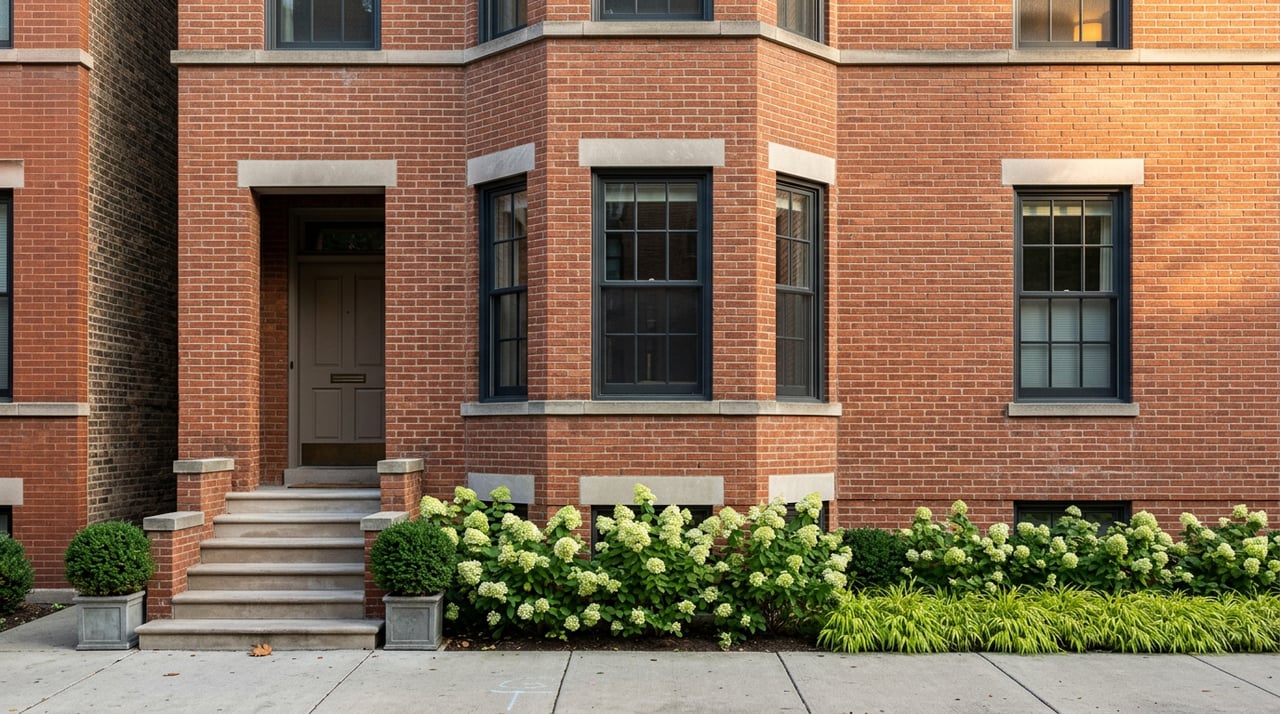
The first is vintage two-flat and three-flat stock, mostly built in the 1880s through the 1920s, concentrated in Ukrainian Village and East Village. These buildings typically run 2,400 to 3,200 square feet total across two units on a standard 25-by-125-foot Chicago lot. A meaningful share of buyers looking at this stock are not planning to keep it as a rental building. They are pricing the cost of deconversion, the process of turning a two-unit building into one single-family home, against building new from scratch. Contractor pricing guides put a full two-flat deconversion at $250,000 to $500,000 in the current Chicago market, on top of the acquisition cost. That math only works if the underlying building costs less than land plus new construction, which is exactly the trade many families are making. A journalism investigation into the trend describes West Town, alongside North Center and Lakeview, as one of the higher-cost North and Northwest Side neighborhoods where small multi-unit buildings are being converted into single-family homes as higher-income buyers seek more space and privacy than the existing single-family stock can supply.
The second product is the industrial loft conversion, concentrated in former warehouses along Grand Avenue and Chicago Avenue. These buildings come with 12 to 14 foot ceilings, exposed brick, and original timber beams, but also with concrete subfloors that make plumbing relocation expensive, century-old plumbing risers, and HOA boards that restrict construction hours and noise because the building is shared vertically in a way a two-flat is not. A loft buyer is pricing character and volume. A two-flat buyer is pricing land and layout. They are not shopping the same comp set even when the listings sit three blocks apart.
The third product is new boutique construction, clustering around Smith Park and Noble Square, where five- and six-unit elevator buildings have been replacing single lots one at a time. Recent development activity tracked by Urbanize Chicago shows how steadily this pipeline has been moving through the city's approval process this year:
None of these are the kind of large-scale development that shows up in a citywide headline. They are the kind of one-lot-at-a-time infill that quietly resets what "new construction in West Town" means, block by block, without ever producing a press release.
Redfin's median sale price is built from actual closed transactions in a given window. When a disproportionate share of that window's closings happen to be new boutique condos or fully renovated deconversions, the median tilts upward, because those are the higher-priced transactions clearing at that moment. Zillow's index is modeled off the entire estimated housing stock, including the older, unrenovated two-flats and modest loft units that are not actively transacting. It is not wrong to be lower. It is measuring a wider, older base.
The practical result for a buyer comparing neighborhoods after a portal search is that the headline number tells you almost nothing about what a specific budget actually buys. A buyer with $575,000 to spend is not competing for the same properties as a buyer at $715,000, and the type of product available at each price point differs by more than finish level. It differs by structure, by renovation risk, and by who else is bidding against you.
Ukrainian Village illustrates the point sharply. Redfin reported a January 2026 median there near $870,000, a sizable jump year over year, well above the West Town-wide figure. That premium is not abstract neighborhood cachet. It reflects a concentration of exactly the deconverted single-family product described above, competing against a shrinking supply of comparable large-lot vintage buildings in a neighborhood that was never built with many freestanding single-family homes to begin with.
If you are comparing West Town against another North Side neighborhood using the median alone, you are comparing an average of three unrelated products against whatever that other neighborhood's stock happens to be. A more useful comparison starts by deciding which of the three products you are actually shopping, then pulling comps only within that category.
If you are looking at vintage two-flat stock with an eye toward deconversion, the relevant math is not the sale price alone. It is sale price plus a realistic renovation budget, since century-old buildings in this category often carry knob-and-tube electrical, balloon-frame construction, and galvanized plumbing that need full replacement regardless of how the finishes look in listing photos.
If you are looking at a loft conversion, the comparison point is building-specific rather than block-specific. HOA reserve health, noise restriction bylaws, and the age of shared mechanical systems matter more here than in a standalone two-flat, because you are buying into a shared structure with other owners whose renovation timelines and board decisions will affect your unit.
If you are looking at new boutique construction, the relevant question is less about the sale price today and more about pipeline. The addresses moving through permitting this year, from Chicago Avenue to Grand Avenue, give a reasonably current read on where new supply is actually landing, which affects both near-term inventory and how a given block will look in three years.
Broader Chicago financing conditions are worth keeping in view regardless of which product you are shopping. Freddie Mac's Primary Mortgage Market Survey put the average 30-year fixed rate near 6.0 percent in early March 2026, a number that shifts the math on all three product types roughly equally, though the underlying acquisition and renovation costs do not move together.
Should I trust the sale price or the modeled value estimate more? Neither one alone. The sale price tells you what recently closed, which is useful if you are buying the same type of product that just transacted. The modeled index tells you a broader average across the full housing stock, useful for a general sense of direction but less useful for pricing a specific unit.
Is a lower price in West Town's vintage stock actually a better deal? Only after you price the renovation. A two-flat that looks less expensive per square foot than a new boutique condo can end up costing more once electrical, plumbing, and structural work are factored in, particularly if a deconversion is part of the plan.
Does the West Town median tell me anything about Ukrainian Village or East Village specifically? Not reliably. Those pockets have their own transaction mix, and Ukrainian Village in particular has been running well above the broader West Town figure because of its concentration of large-lot vintage stock.
The median is a starting point, not a verdict. West Town's real story is in which of its three housing products a given transaction actually belongs to, and that is a conversation worth having with someone who tracks the block-by-block permit activity as closely as the price data.
If you are weighing a purchase or sale in West Town and want a read on how a specific block or building type is actually performing, The BRAND Real Estate Group is glad to walk through it with you. Request a White-Glove Market Consultation and we will bring the comps that actually match what you are buying, not just the neighborhood average.
Stay up to date on the latest real estate trends.






We pride ourselves in providing personalized solutions that bring our clients closer to their dream properties and enhance their long-term wealth. Contact us today to discuss all your real estate needs!

THE BRAND GROUP
1775 N CLYBOURN AVE #1 CHICAGO IL 60614